

🌿 Key Takeaways
- Indoor light affects mood, productivity, sleep quality, plant health, and the overall feel of every room in your home
- Grow lights for indoor plants are not just for professional growers — any plant owner with limited natural light can use them effectively
- What are grow lights? They are artificial light sources designed to emit the specific light spectrum that plants use for photosynthesis
- Best grow lights for indoor plants are full-spectrum LED grow lights — energy-efficient, long-lasting, and suitable for seedlings through mature plants
- What kind of light do plants need? Most indoor plants need bright indirect light equivalent to 1,000–2,000 foot-candles — achievable with the right plant grow lights setup
- Can normal light bulbs grow plants? Standard incandescent bulbs cannot — only full-spectrum plant lights or dedicated grow lamps provide the correct light spectrum
- What is medium light for plants? Medium light is 25–50 foot-candles — the condition found 1–2 metres from a window, where snake plants and peace lilies thrive
- Browse our full indoor plant care guides for plant-specific light requirement information
Why Indoor Light Is the Most Underestimated Factor in Plant Care and Home Design
Light is the invisible architecture of every room. It shapes how spaces feel, how colours read, how moods shift through the day — and for anyone growing plants indoors, it determines whether those plants survive, struggle, or genuinely thrive.
Most plant owners focus on watering schedules and soil mixes when things go wrong. But indoor light is almost always the root cause of underperforming houseplants — more so than watering mistakes, incorrect soil, or neglected fertilizing. A plant receiving insufficient light cannot photosynthesize efficiently. It cannot produce energy. And without energy, every other care effort becomes progressively less effective.
This complete guide covers the full spectrum of indoor light — from understanding the different types of lighting for your rooms to the science of grow lights for indoor plants, how to choose the best grow lights for indoor plants, and how to use plant grow lights correctly for every species from herbs to rare tropical varieties.
Whether you are trying to brighten a poorly lit room, rescue a struggling houseplant, or build a serious indoor growing setup — everything you need is here.
Understanding Indoor Light — The Fundamentals
What Kind of Light Do Plants Need?
What kind of light do plants need is the foundational question in all of indoor plant care — and the answer is more nuanced than most care guides acknowledge.
Plants use light for photosynthesis — the process of converting light energy into glucose that fuels growth. But not all light is equally useful. Plants primarily use two wavelength ranges:
- Blue light (400–500nm): Drives vegetative growth — leaf production, stem development, and compact bushy growth habits
- Red light (600–700nm): Drives flowering and fruiting — essential for plants to bloom and produce seeds
Standard household lighting — whether incandescent, CFL, or basic LED — does not reliably cover both these wavelength ranges. This is why dedicated grow lights for plants and full-spectrum plant lamps are necessary for plants grown in limited natural light conditions.
What Is Medium Light for Plants?
What is medium light for plants is one of the most searched indoor plant questions — and one of the most poorly explained in standard care guides.
Light levels for indoor plants are measured in foot-candles (fc) or lux:
| Light Level | Foot-Candles | Lux | Distance from Window |
|---|---|---|---|
| Bright direct light | 2,000–5,000 fc | 21,500–53,800 lux | At window, direct sun |
| Bright indirect light | 1,000–2,000 fc | 10,750–21,500 lux | 30–60cm from bright window |
| Medium light | 250–1,000 fc | 2,690–10,750 lux | 1–2 metres from window |
| Low light | 25–250 fc | 270–2,690 lux | 2+ metres from window |
| Very low light | Below 25 fc | Below 270 lux | Dark corners, windowless rooms |
What is medium light for plants specifically? It is the light level found approximately 1 to 2 metres from a bright window — enough for plants like peace lilies, snake plants, and pothos to thrive without supplemental lighting.
What Are Grow Lights?
What are grow lights? A grow light is an artificial light source designed specifically to provide the light spectrum that plants use for photosynthesis — either supplementing natural light in low-light environments or completely replacing it in windowless spaces.
What is grow light technology based on? Modern grow lights use LED, fluorescent, or high-intensity discharge (HID) technology to produce light across the specific wavelength ranges plants need — primarily blue (400–500nm) and red (600–700nm) light, often combined into what is called a full-spectrum output.
Understanding what are grow lights and how they work is the starting point for using them effectively — whether you are growing herbs, houseplants, or seedlings under artificial light.
Types of Indoor Lighting — For Rooms and Plants
Ambient Lighting
The foundational layer of indoor light for any room — ambient lighting provides general illumination from ceiling fixtures, recessed lights, or wall-mounted sources. Ambient lighting alone creates flat, uniform light without visual interest or the directed quality needed for either comfortable living spaces or healthy plant growth.
Task Lighting
Focused indoor light for specific activities — desk lamps, under-cabinet kitchen lights, and reading lights. For plants, dedicated plant grow lights and grow lamps serve a task lighting function — providing targeted light precisely where plants need it most.
Accent Lighting
Decorative, mood-setting indoor light — LED strips, wall sconces, and picture lights. While accent lighting contributes minimally to plant growth (most operates at far too low a light level), it contributes significantly to the overall aesthetic of indoor plant displays.
Natural Light — The Gold Standard
Natural light provides the complete spectrum that all plants evolved to use. It changes throughout the day in intensity and color temperature — mimicking the light cycles that regulate plant growth, flowering, and dormancy. No artificial light source fully replicates natural light, though modern full-spectrum LED grow lights for indoor plants come closer than ever before.
Window orientation and natural light:
- South-facing windows: Maximum light intensity — 6–8 hours of direct sun daily. Best for cacti, succulents, herbs, and fruiting plants
- East-facing windows: Gentle morning direct sun followed by bright indirect light. Ideal for most tropical houseplants
- West-facing windows: Afternoon direct sun — more intense than east exposure. Suits most medium-light plants
- North-facing windows: Indirect light only — sufficient only for genuinely low-light tolerant species
Grow Lights for Indoor Plants — Complete Guide
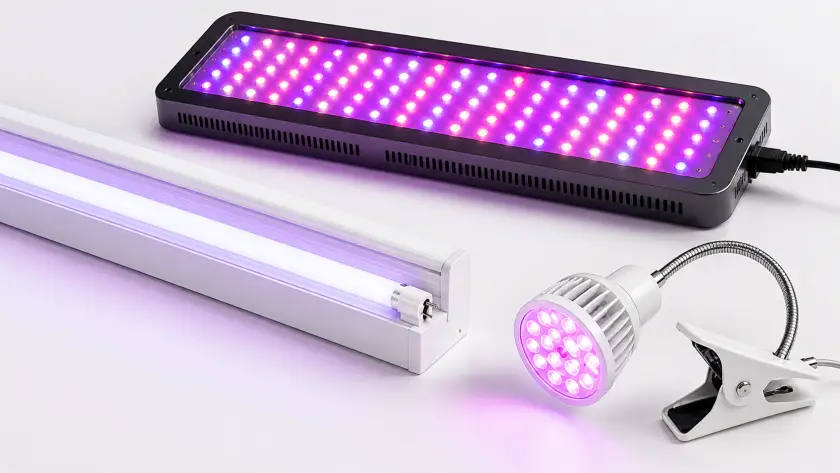
What Are Grow Lights and How Do They Work?
What is grow light technology and how does it actually help plants? Grow lights work by emitting light at the specific wavelengths (colors) that plant chlorophyll absorbs for photosynthesis. Standard household bulbs emit light across a broad spectrum, but only a portion of that spectrum is useful to plants. Dedicated plant lights concentrate output in the wavelength ranges plants actually use — making them far more effective per watt of energy consumed.
Do Plant Lights Work?
Do plant lights work for real, or are they a marketing gimmick? The answer is definitively yes — plant grow lights work extremely effectively when chosen and used correctly. Plants grown under quality indoor grow lights often grow as vigorously as those in good natural light — sometimes more so, because the light is consistent and controllable.
Do regular light bulbs help plants grow? Standard incandescent bulbs produce light that is too red-heavy and too heat-intensive to be useful for plant growth. Can normal light bulbs grow plants effectively? No — they produce insufficient light in the wavelengths plants need while generating excessive heat that can damage plants positioned close enough to receive meaningful light.
Types of Grow Lights — Which One Should You Choose?
LED Grow Lights for Indoor Plants
LED grow lights for indoor plants are the current gold standard — and the most recommended option for home growers at any scale. Indoor LED plant grow lights offer:
- Full spectrum output covering both blue and red wavelengths plants need
- Low heat generation — can be positioned close to plants without heat damage risk
- Energy efficiency — use 50–70% less electricity than HID alternatives
- Long lifespan — quality led grow lights for indoor plants last 50,000+ hours
- Adjustable spectrum — many models allow you to control the ratio of blue to red light
What is the best grow light for indoor plants in the LED category? Full-spectrum LED panels from reputable brands that specify their PPFD (Photosynthetic Photon Flux Density) output are the most reliable choices. Look for PPFD ratings appropriate to your plant type — herbs and seedlings need 200–400 PPFD; fruiting plants need 600–900 PPFD.
Grow Lamps — Fluorescent Options
Grow lamps using fluorescent technology — particularly T5 fluorescent tubes — remain effective and affordable options for seedlings, herbs, and low to medium light plants. Grow lamp light from T5 fluorescents provides even coverage across wide growing areas and runs cooler than HID alternatives.
Grow lamps are particularly effective for:
- Seed starting and propagation
- Herb gardens on kitchen counters
- Low-light houseplants needing supplemental light in winter
- Large growing areas where LED panel coverage would be insufficient
How do grow lamps work using fluorescent technology? They pass electrical current through a gas-filled tube, causing the gas to emit UV light that excites a phosphor coating on the tube interior — which then emits visible light. Full-spectrum fluorescent grow lamps are coated to emit light across the wavelengths plants need.
High-Intensity Discharge (HID) Grow Lights
HID grow lights — including Metal Halide (MH) and High-Pressure Sodium (HPS) — produce extremely intense light suitable for large-scale indoor growing. They are generally not recommended for home plant owners due to high heat output, significant energy consumption, and the need for additional cooling equipment. For home use, LED grow lights for indoor plants are almost always a better choice.
Best Grow Lights for Indoor Plants — Recommendations by Use Case
Best Grow Lights for Seedlings and Propagation
What color grow light for seedlings produces the best results? Blue spectrum light (5,000–7,000K color temperature) drives the compact, leafy growth that seedlings need in their first weeks. A T5 fluorescent grow lamp or full-spectrum LED panel set to blue-dominant output is ideal for seedlings.
What color grow light is best for indoor plants in general? Full-spectrum plant grow lights that cover both blue (400–500nm) and red (600–700nm) wavelengths are best for established houseplants — supporting both healthy leaf growth and potential flowering. For seedlings specifically, blue-dominant light produces the strongest, most compact early growth.
Best Indoor LED Plant Grow Light for Houseplants
For general houseplant growing, the best grow lights for indoor plants are full-spectrum LED panels that:
- Specify PPFD output (not just wattage) — PPFD tells you actual light intensity reaching the plant
- Cover 400–700nm wavelength range — this is the PAR (Photosynthetically Active Radiation) range
- Are dimmable — allowing adjustment for different plant light requirements
- Have a built-in timer or are compatible with an external timer — consistent light cycles are essential
Plant Lamp Options for Desk and Small-Scale Growing
Plant lamp options for smaller-scale growing — individual pots on desks, windowsills, and shelves — include clip-on plant lamp units that attach to pot rims or shelf edges, freestanding plant lamp designs that stand beside individual plants, and multi-arm plant lamp units that position individual LED heads over multiple pots simultaneously.
For plants on shelves and bookcases, individual plant lamp units positioned above each shelf level are the most effective supplemental lighting solution for darker rooms.
How to Use a Grow Light — Practical Guide
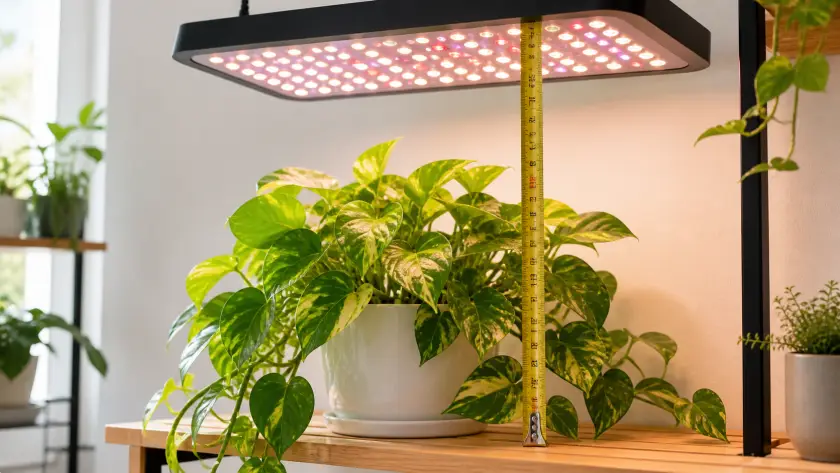
How to Use a Grow Light for Houseplants
How to use a grow light correctly makes the difference between plants that simply survive under artificial light and plants that genuinely thrive. How to use a grow light for houseplants follows these core principles:
Step 1 — Determine Your Plant’s Light Requirement
Different plants need very different light intensities. Before setting up plant grow lights indoor, identify what your specific plants need:
| Plant Type | Light Need | PPFD Target | Recommended Distance from LED |
|---|---|---|---|
| Low-light plants (snake plant, pothos) | 100–300 PPFD | Low intensity | 60–90cm |
| Medium-light plants (peace lily, philodendron) | 300–600 PPFD | Medium intensity | 30–60cm |
| High-light plants (herbs, succulents) | 600–900 PPFD | High intensity | 15–30cm |
| Fruiting/flowering plants | 900–1,500 PPFD | Very high | 10–20cm |
Step 2 — Set the Correct Distance
Plant lights positioned too close cause light burn — bleached, yellowing, or crispy leaf margins. Too far and the light intensity is insufficient for useful photosynthesis. Start at the manufacturer’s recommended distance and observe your plants for 1–2 weeks before adjusting.
Step 3 — Establish a Consistent Light Schedule
Can I use grow light for bright indirect light conditions — and for how long daily? Yes — grow lights can create bright indirect light equivalent conditions when set at appropriate PPFD levels and distances. Consistent daily photoperiods are essential:
- Low-light plants: 10–12 hours daily under indoor grow lights
- Medium-light plants: 12–14 hours daily
- High-light plants: 14–16 hours daily
- Seedlings: 14–16 hours daily for most vigorous growth
Always use a timer — consistent light cycles are as important as light intensity. Plants that receive irregular photoperiods can experience stress responses including premature flowering in day-length-sensitive species.
Step 4 — Monitor and Adjust
Watch your plants for signs that plant grow lights are working correctly:
Signs of correct light levels:
- Compact growth with normal internode spacing
- Rich, vivid leaf color
- Normal growth rate for the species
- Healthy new leaf production
Signs of too much light:
- Bleached or washed-out leaf color
- Brown, crispy leaf margins
- Curling leaves
Signs of insufficient light:
- Etiolation (long, stretched stems reaching toward the light source)
- Small, pale new leaves
- Slow or stopped growth
- Leaf drop in tropical species
Growing Herbs with Grow Lights and Artificial Light

Growing Herbs with Artificial Light — Is It Really Possible?
Growing herbs with artificial light is one of the most practical applications of indoor grow lights for home growers. Fresh herbs are expensive at the grocery store, available year-round under plant grow lights, and significantly more flavorful when home-grown. Growing herbs with grow lights is genuinely achievable for any home cook with a spare counter or shelf space.
Growing herbs with grow lights works best when you understand the specific light needs of different herb species:
Growing Herbs with Grow Lights — Best Varieties and Light Requirements
Best herbs to grow with grow lights:
- Basil: Needs 14–16 hours of plant grow lights daily — a high-light herb that produces the most flavorful leaves under intense indoor led plant grow light conditions
- Mint: More shade-tolerant than most herbs — 12–14 hours under moderate plant lights produces excellent results
- Chives: Tolerant of medium light — 12 hours under standard grow lamps is sufficient
- Parsley: Medium-high light requirements — 14 hours under full-spectrum led grow lights for indoor plants works well
- Thyme and oregano: Mediterranean herbs that need high light — position closest to plant grow lights for most productive growth
- Cilantro: Bolts quickly under high heat — use cool-running LED grow lights for indoor plants at moderate intensity
What color grow light is best for indoor plants when growing herbs specifically? For basil, thyme, and other culinary herbs, a blue-dominant spectrum (5,000–6,500K) during vegetative growth keeps plants compact and productive. Switching to more red-dominant output can trigger flowering — which reduces leaf flavor in most culinary herbs.
For a complete guide to growing herbs and edible plants, our guide on growing your own easiest outdoor edible plants for beginners covers the same principles applicable to indoor herb growing.
Indoor Light Setup — Room by Room Guide
Living Room Lighting and Plants
The living room presents the most flexibility for combining decorative indoor light with plant-friendly lighting. Use dimmable warm LED ambient lighting (2,700–3,000K) as your base layer, add floor lamps for reading and task areas, and position plant grow lights discreetly for any plants in lower-light positions.
For living room plant display ideas that work with your lighting setup, our guide on creating an indoor jungle without overcrowding gives detailed arrangement advice.
Bedroom Lighting and Plants
Bedroom indoor light should prioritize sleep quality — meaning warm color temperatures (2,700K maximum) and dimmable fixtures that transition smoothly from daytime working light to evening relaxation light.
For plants in bedrooms, position plant grow lights on timers that switch off 2–3 hours before sleep to avoid disrupting circadian rhythm. Our guide on decorating your bedroom with plants covers the best light-tolerant plants for bedroom environments.
Home Office Lighting and Plants
Home office indoor light has the greatest impact on productivity and eye health. LED task lighting at 4,000–5,000K color temperature reduces eye strain during screen work. Natural light supplemented with smart LEDs that adjust color temperature through the day produces the best results.
For plants in home offices, indoor grow lights positioned away from your primary line of sight prevent glare while supporting plant health under typical office lighting conditions. Our guide on improving your home office with plants covers the best plants for offices with limited natural light. Our dedicated guide on office-friendly plants that survive fluorescent lighting identifies the specific varieties that perform best under artificial office light.
Bathroom Lighting and Plants
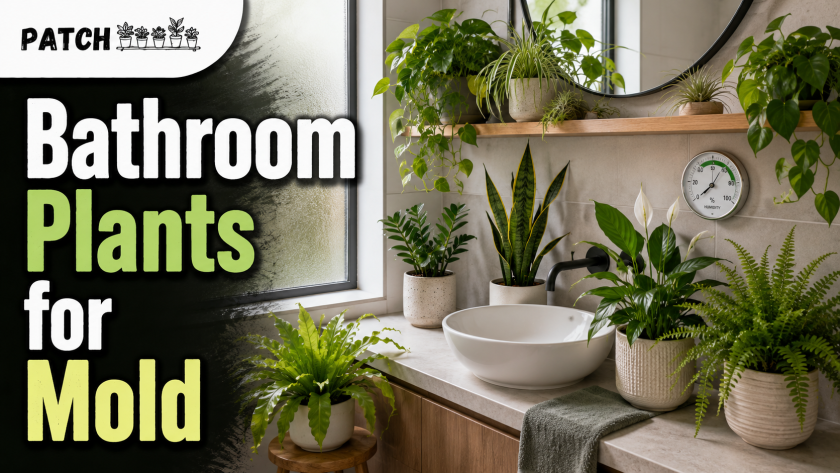
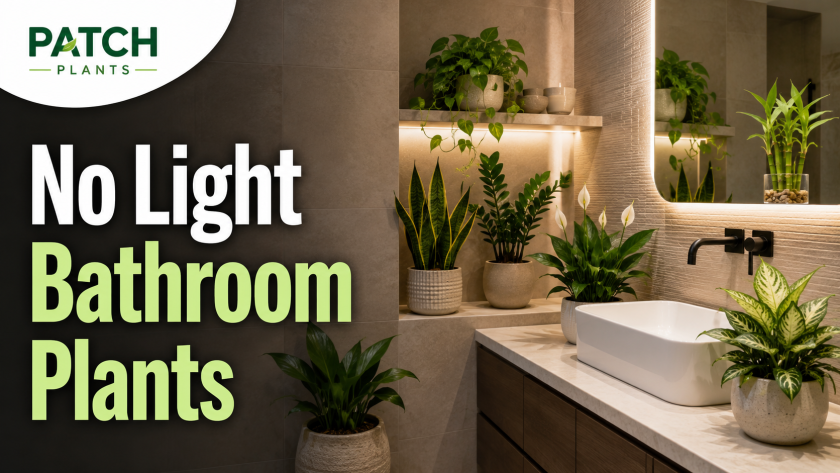
Bathrooms present unique lighting challenges — high humidity, often limited natural light, and the need for both task lighting at mirrors and ambient lighting for relaxation. For plants in bathrooms, the natural humidity reduces moisture stress but artificial plant lights may be needed if natural light is limited.
Our guide on the best plants for your bathroom identifies varieties that thrive under bathroom light conditions — both natural and artificial.
Kitchen Lighting and Plant Grow Lights
Kitchens need the highest task light intensity of any room — bright, cool (4,000K+) light above work surfaces is essential for safe food preparation. Under-cabinet LED strips serve double duty — illuminating countertops and providing supplemental plant lamp light for any herbs growing on windowsills or shelves nearby.
Natural Light vs Artificial Light for Plants
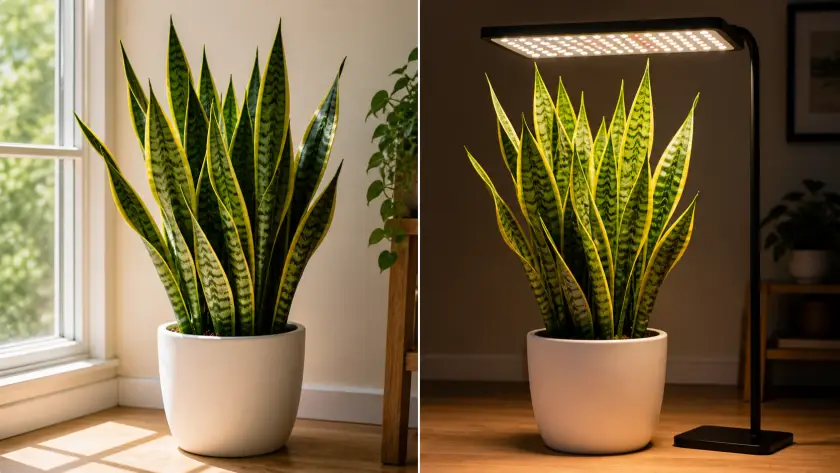
Natural Light vs Artificial Light — Key Differences
Natural light vs artificial light for plants is not a binary choice — the most successful indoor plant setups combine both strategically.
| Factor | Natural Light | Artificial Plant Lights |
|---|---|---|
| Spectrum | Complete, full spectrum | Varies — full-spectrum LED comes closest |
| Consistency | Varies with weather and season | Completely consistent on a timer |
| Cost | Free | Electricity cost + equipment investment |
| Controllability | Cannot be adjusted | Fully adjustable intensity and schedule |
| UV content | Contains beneficial UV | Most grow lights lack UV |
| Seasonal variation | Dramatically reduced in winter | Constant year-round |
| Heat | Minimal when indirect | Varies by type — LED produces least |
Can I Use Grow Light for Bright Indirect Light Conditions?
Can I use grow light for bright indirect light simulation? Yes — a full-spectrum LED plant grow light set at the appropriate PPFD level and distance can effectively simulate bright indirect light conditions for most tropical houseplants. The key is matching the PPFD output to the equivalent natural light level your plant needs.
For plants that specifically need bright indirect light — like fiddle leaf figs, peace lilies, and most aroids — a quality indoor LED plant grow light positioned at 30–60cm provides equivalent conditions when run for 12–14 hours daily.
Indoor Light and Specific Plant Types
Low-Light Plants — What They Actually Need
Low-light plants like snake plants, pothos, and ZZ plants tolerate low indoor light conditions — but “tolerate” is the key word. They survive in low light but grow best in medium light. Our dedicated guide on low-light hanging plants for shelves and showers covers the best genuinely low-light tolerant varieties.
Air-Purifying Plants and Light Requirements
Air-purifying houseplants like peace lilies and spider plants need adequate light to maintain the metabolic activity that drives their air-purification function. A plant in insufficient light photosynthesizes less — meaning its air-purifying capacity is proportionally reduced. Our guide on air-purifying indoor plants that actually work covers the specific light requirements of the most effective air-purifying species.
Rare and Unusual Houseplants — Light Considerations
Many rare houseplants have specific and demanding light requirements that standard window positions cannot reliably provide. Indoor grow lights make it possible to maintain rare tropical species that would otherwise fail in typical home conditions — expanding the range of plants you can grow successfully regardless of your home’s natural light situation.
Feng Shui and Indoor Light
Indoor light plays a central role in Feng Shui practice — both natural and artificial light affect the chi energy of a space. Our guide on Feng Shui indoor plants covers how to combine plant placement and lighting to maximize positive energy flow in your home.
Colorful Foliage Plants and Light
Colorful foliage plants — variegated varieties, purple-leafed species, and plants with metallic or iridescent textures — are particularly light-sensitive. The vibrancy of their non-green coloration depends directly on adequate light levels. Our guide on colorful foliage indoor plants that aren’t just green covers the specific light requirements of the most striking variegated and colored varieties.
Choosing the Best Indoor Light Bulbs
Best Indoor Light Bulbs — Complete Comparison
| Bulb Type | Best For | Color Temperature | Lifespan | Energy Use |
|---|---|---|---|---|
| Full-spectrum LED | Most rooms + plants | 2,700K–6,500K adjustable | 25,000–50,000 hrs | Very low |
| Warm white LED | Bedrooms, living rooms | 2,700–3,000K | 25,000 hrs | Very low |
| Cool white LED | Offices, kitchens | 4,000–5,000K | 25,000 hrs | Very low |
| CFL | Budget option | 2,700–6,500K | 8,000–10,000 hrs | Low |
| Halogen | Reading, detail work | 3,000K | 2,000 hrs | Medium-high |
| Incandescent | Decorative only | 2,700K | 1,000 hrs | Very high |
LED Lighting — The Best Investment for Home and Plants
LED lighting serves double duty for plant owners — providing quality room illumination while offering the closest available artificial approximation of natural daylight spectrum. Switching entirely to LED reduces electricity costs significantly while improving light quality for both human comfort and plant health.
Troubleshooting Indoor Light Problems for Plants
Signs Your Plant Is Getting Too Little Light
- Etiolation — long, stretched stems reaching toward the light source
- Small, pale, or washed-out new leaves compared to older growth
- Leaf drop in tropical species — the plant shedding leaves it cannot support
- No growth despite correct watering and feeding
When these signs appear, move the plant closer to a window or add plant grow lights as supplemental lighting.
Signs Your Plant Is Getting Too Much Light
- Bleached, whitened, or washed-out leaf color
- Brown, crispy patches on leaves facing the light source
- Wilting despite adequate watering — excessive light drives too much transpiration
Move the plant further from the window or increase the distance between the plant and its grow light.
Seasonal Light Changes — Winter Is the Critical Period
Many plant care problems that appear in winter are actually light problems. As daylight hours decrease, natural light intensity drops significantly — particularly in northern latitudes. Plants that thrived on window light all summer may begin struggling in October and November as available light falls below their minimum threshold.
Winter light solutions:
- Add indoor grow lights on timers to supplement reduced natural light
- Move plants closer to windows — even 30cm can make a significant difference
- Clean windows thoroughly — dirty glass reduces light transmission by up to 20%
- Use mirrors and light-colored walls to reflect and amplify available natural light
Our guide on humidity hacks for happy plants covers winter plant care holistically — light reduction and heating-driven humidity loss are the two most common winter plant stressors.
Frequently Asked Questions
What Are Grow Lights and Do They Actually Work?
What are grow lights? They are artificial light sources designed to emit the specific light wavelengths (blue 400–500nm and red 600–700nm) that plants use for photosynthesis. Do plant lights work effectively? Yes — quality full-spectrum grow lights for plants allow plants to grow as vigorously under artificial light as they would in good natural light. They are not a gimmick — they are a practical, evidence-based solution to limited natural light.
What Is the Best Grow Light for Indoor Plants?
What is the best grow light for indoor plants in most home settings? Full-spectrum LED grow lights that specify their PPFD output are the most reliable and versatile choice. For general houseplant care, a mid-range full-spectrum LED panel with a timer produces excellent results. What is the best grow light for plands like herbs specifically? High-PPFD full-spectrum LED panels or T5 fluorescent grow lamps positioned 15–30cm above herb containers produce the most productive herb gardens.
Can Normal Light Bulbs Grow Plants?
Can normal light bulbs grow plants effectively? No — standard incandescent bulbs produce insufficient light in the blue and red wavelengths plants need for photosynthesis. Do regular light bulbs help plants grow at all? They provide minimal benefit compared to dedicated plant grow lights. The heat they generate relative to usable light output makes them inefficient and potentially harmful to plants positioned close enough to receive meaningful light.
How to Use a Grow Light for Houseplants Correctly?
How to use a grow light for houseplants effectively: determine your plant’s PPFD requirement, position the light at the correct distance for that PPFD level, set a timer for 10–16 hours daily depending on the plant type, and monitor for signs of too much or too little light. Adjust distance and duration based on plant response over the first 2–4 weeks. Consistent photoperiods are as important as light intensity — use a timer without exception.
What Color Grow Light Is Best for Indoor Plants?
What color grow light is best for indoor plants in general? Full-spectrum lights covering both blue (400–500nm) and red (600–700nm) wavelengths produce the most balanced results for established houseplants. What color grow light for seedlings specifically? Blue-dominant light (5,000–7,000K) drives the compact vegetative growth seedlings need. Red-dominant light encourages flowering — useful for orchids and other blooming species but counterproductive for leafy herbs.
What Is Medium Light for Plants in Practice?
What is medium light for plants in real-world terms? It is the light level found approximately 1 to 2 metres from a bright window — around 250–1,000 foot-candles or 2,690–10,750 lux. Medium light is sufficient for many popular houseplants including peace lilies, heartleaf philodendrons, snake plants, and pothos. Plants needing medium light placed in low-light positions will gradually decline — supplemental plant grow lights can reliably restore medium light conditions anywhere in the home.
Can I Use Grow Light for Bright Indirect Light Simulation?
Can I use grow light for bright indirect light equivalence? Yes — full-spectrum LED grow lights for indoor plants set at 300–600 PPFD and positioned 30–60cm from the plant canopy simulate bright indirect light conditions effectively for most tropical houseplants. Run the lights for 12–14 hours daily on a timer for consistent results equivalent to a well-lit east-facing window position.
How Do Grow Lamps Work Compared to Regular Lamps?
How do grow lamps work differently from standard household lamps? Standard lamps prioritize human visual comfort — emitting light that appears bright to human eyes but may lack the specific wavelengths plants use for photosynthesis. Grow lamps prioritize plant-usable light output — maximizing emission in the blue and red wavelength ranges that drive photosynthesis, regardless of how that light appears to human eyes. This is why some grow lamps appear purple or pink — they are optimized for plant use, not human vision.
Related Guides on Patch Plants
- 🐍 Snake Plant Care Guide — Light, Water & Complete Care
- 🌸 Peace Lily Care Guide — Complete Spathiphyllum Tips
- 🌿 Low-Light Hanging Plants for Shelves & Showers
- 🏢 Office-Friendly Plants That Survive Fluorescent Lighting
- 🌱 Trailing Plants That Look Stunning on Shelves & Bookcases
- 🌿 Air-Purifying Indoor Plants That Actually Work
- 🏠 How to Style Indoor Plants by Room
- 💧 Complete Watering Guide for Healthy Thriving Plants
- 🌱 Browse All Indoor Plant Guides
Final Thoughts
Indoor light is the invisible foundation beneath every other plant care decision you make. The right grow lights for indoor plants, positioned correctly and run on consistent timers, can transform any space — no matter how dark — into a thriving environment for any plant you choose to grow.
Understanding what kind of light do plants need, what is medium light for plants, and how to use a grow light for houseplants correctly removes the single biggest barrier to successful indoor plant growing. Once light is managed well, every other care practice becomes more effective — because a plant receiving adequate light can actually use the water, nutrients, and humidity you provide.
Whether you start with a single plant lamp above a struggling houseplant, a row of grow lamps over a kitchen herb garden, or a full indoor grow lights system for a dedicated plant room — the investment in quality light pays dividends in plant health, growth, and the quiet satisfaction of watching a previously struggling plant genuinely thrive.
According to the Royal Horticultural Society, light is the single most important environmental factor in indoor plant health — more so than watering, feeding, or humidity in most cases. Getting light right is always the first step. 🌿
[…] understanding how light levels affect plant selection both indoors and outdoors, our complete guide to indoor light covers light measurement principles that apply equally to outdoor shade […]
[…] related indoor growing help, read the complete indoor light guide, complete watering guide, and best soil mix […]
[…] you are still building confidence with plant care, start with our best indoor plants for beginners, complete indoor light guide, and complete watering guide. Flowering plants are easier to manage when these basics are […]